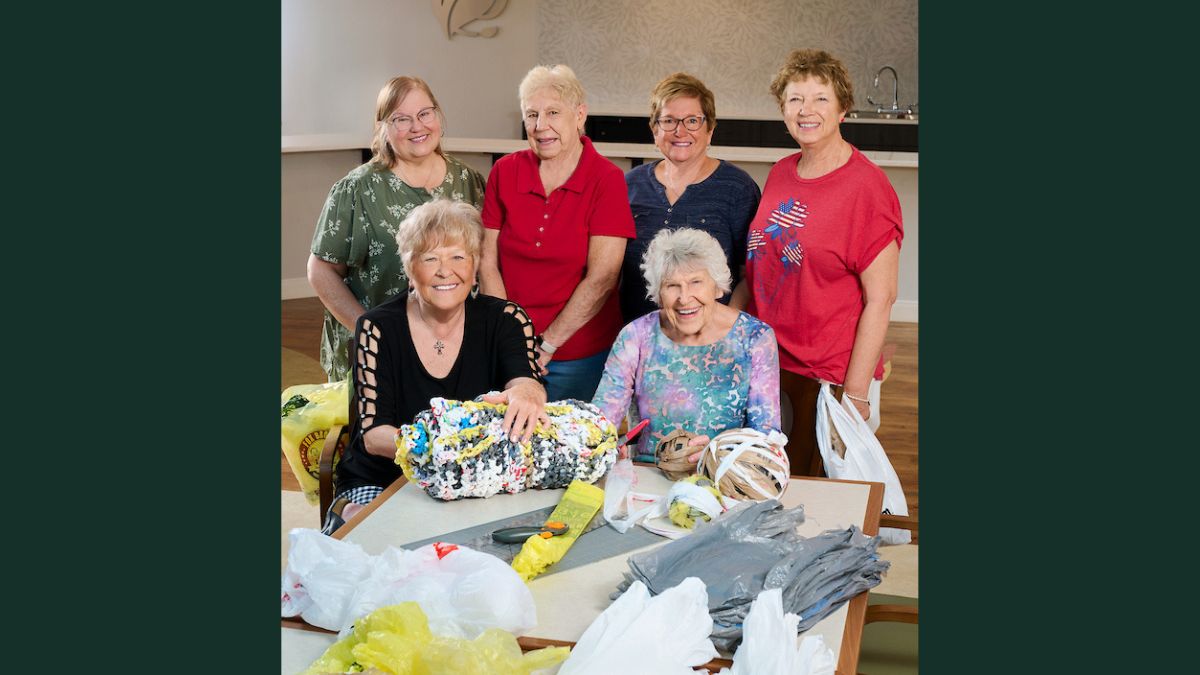
On Monday mornings at Cedar Community’s Cedar Ridge Campus, a group of residents gathers around tables in the Bistro to flatten, cut, knot, and crochet plastic grocery bags into sleeping mats for people experiencing homelessness.
They call themselves the “Bag Ladies,” and their weekly project is about much more than recycling. It’s a way to give back, build friendships, and turn something ordinary into something meaningful.
A Volunteer Spirit That Came Full Circle
Jean Gorman has lived in Cedar Community’s independent living for about three and a half years.
“I knew someday I was going to live here,” she says.
Jean’s connection to Cedar Community began long before she became a resident. She previously worked as an occupational therapist at Cedar Community for 10 years during the days of Rev. Riesch, the organization’s founder and first executive director.
Jean has always had a passion for helping others and describes herself as a “volunteer queen.”
For more than two decades, she has worked with organizations including the Society of St. Vincent de Paul and her parish, St. Mary’s Catholic Church. Her volunteer work has often involved meeting directly with individuals and families in need.
“We go in pairs,” she explains. “If someone needs help with rent, clothing, or utilities, we visit and figure out what we can do. People are just so grateful.”
That same spirit of service eventually led Jean to a project at Cedar Community that transforms recycled plastic bags into sleeping mats for people experiencing homelessness.
From Bags to Beds
The idea began after Jean heard a presentation from Bob Burmeister, founder and president of Mr. Bob’s Under the Bridge, an organization that supports people experiencing homelessness.
Inspired by his message, Jean and fellow Cedar Community resident Marilyn Brath decided to help by creating sleeping mats from recycled plastic grocery bags.
Before long, other residents joined them.
The process starts with Marilyn, who jokingly calls herself the “dumpster diver” as she collects recycled plastic bags from local stores, with permission.
“Fortunately, we haven’t run into too many surprises in those plastic bags,” laughs Marilyn. “Maybe a little grease, but that’s it.”
Additional bags are collected from neighbors.
Each bag is flattened, cut into strips about two and a half inches wide, and looped together to create long strands of plastic yarn. Those strands are rolled into balls and eventually crocheted into durable sleeping mats.
Each finished mat measures roughly three by six feet and requires between 800 and 900 plastic bags.
“It sounds like a lot,” Jean says, “but once you get going, it adds up.”
The mats are lightweight, waterproof, and provide insulation from the ground, giving someone a dry surface to sleep on.
A Group Effort
The group meets weekly and may include anywhere from a handful of residents to around 10 people at a time.
Some residents cut bags. Others connect strips. A few crochet the finished mats.
Everyone can contribute in their own way and on their own schedule.
Since January 2026 the project has produced more than 13 mats.
Marilyn especially values the camaraderie and social connection that come with the weekly gathering.
She also has a long history of giving back, including collecting and sending cards to local veterans and volunteering monthly at the Foster Closet.
For Jean and Marilyn, the project has an added benefit: something that might otherwise become waste is instead turned into something useful for another person.
More Than Mats
Volunteering has also created something meaningful for the residents who participate: connection with one another.
“There’s a lot of socializing,” Jean laughs. “People come down, they talk, they laugh — it matters.”
The weekly gathering gives residents a chance to meet neighbors, share stories, spend time together, and feel part of something larger than themselves.
“You find out you’re helping someone who doesn’t have anything,” Marilyn says. “That makes a difference.”
The project is one example of how volunteering at Cedar Community can create purpose both inside and beyond the community.
How to Support the Project
The group accepts plastic grocery bag donations, which can be dropped off at the Cedar Ridge Campus reception desk at:
113 Cedar Ridge Drive
West Bend, WI
Sendik’s bags are too thick for the project, and Woodman’s bags tend to disintegrate, so those bags cannot be used.Originally published in the Summer 2026 issue of Live More magazine.